 UNAIDS Asia-Pacific
New World AIDS Day report warns funding crisis has thrown the global AIDS response into turmoil
Asia-Pacific faces a dangerous financial squeeze that is undermining prevention and community support
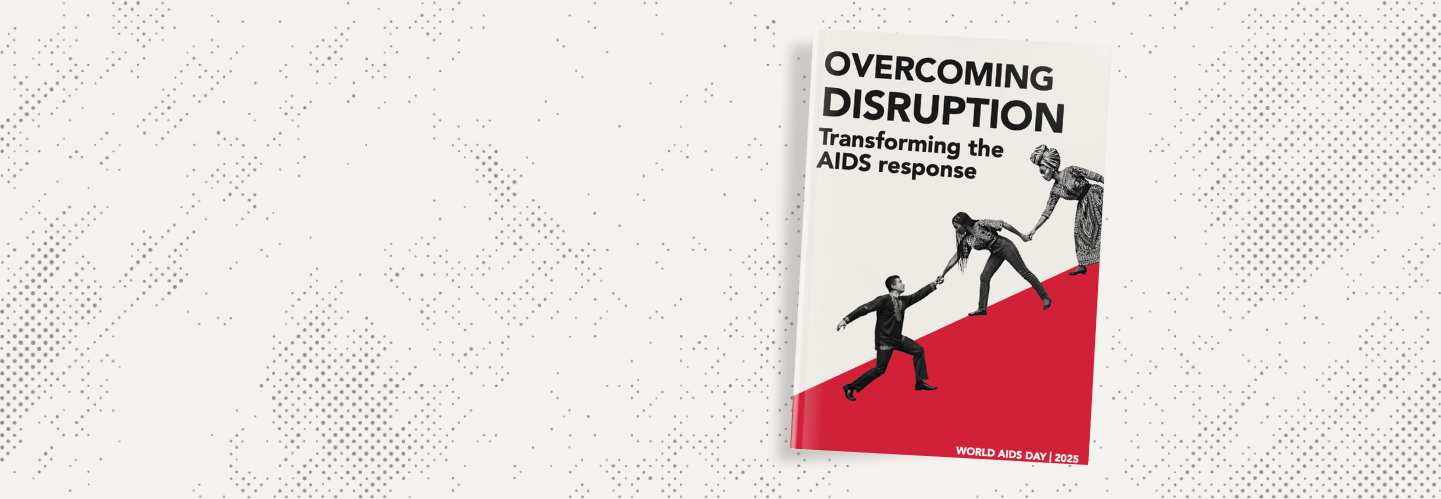
GENEVA/BANGKOK, 26 November 2025—The AIDS response has suffered its most serious setback in decades, warns a new UNAIDS report released ahead of World AIDS Day (1 December). Overcoming Disruption, Transforming the AIDS Response details how a sharp fall in international funding is hitting low- and middle-income countries hardest and threatening to reverse hard-won gains.
“The funding crisis has exposed the fragility of the progress we fought so hard to achieve,” said Winnie Byanyima, Executive Director of UNAIDS. “Behind every data point in this report are communities suddenly left without services and care. We cannot abandon them. We must overcome this disruption and transform the AIDS response.”
The Asia-Pacific situation
The funding crisis has struck just as Asia-Pacific is grappling with a deepening HIV prevention crisis. Between 2010 and 2024, new HIV infections rose in nine countries: Fiji (3091% from a very small baseline), the Philippines (562%), Afghanistan (187%), Papua New Guinea (84%), Bhutan (67%), Sri Lanka (48%), Timor-Leste (42%), Bangladesh (33%) and Lao PDR (16%). For the region as a whole, prevention progress has been slow. Since 2010, new HIV infections fell by only 17%, half the speed of the global average decline (40%).
The UNAIDS 2025 Global AIDS Update confirms that external funding for the region’s HIV programmes declined by 54% since 2010. Domestic HIV resources fell during COVID-19 but saw a moderate increase last year. Still, the total resources available for the response remain inadequate. The report shows that funding specifically for prevention and community-led services is shrinking or stagnating in several countries.
Prevention programmes in Asia-Pacific remain heavily dependent on external funding. In many countries, donor investments still power HIV services for key populations, including men who have sex with men, sex workers, people who use drugs and transgender people. New analysis of HIV spending between 2019 and 2024 shows that on average countries in the region rely on donors for more than a quarter (27%) of their prevention budgets. However, several nations use international sources for more than 50% of prevention financing including Cambodia (98%), Papua New Guinea (95%) and Lao PDR (84%).
While the full impact of this year’s cuts is still emerging, early evidence from some countries shows drops in the numbers of people using oral pre-exposure prophylaxis (PrEP) where donor-funded programmes have been disrupted. In Viet Nam, for example, the use of PrEP, a critical prevention option, fell by 21% between late 2024 and mid-2025.
“Cutting prevention is the most expensive mistake governments and donors can make,” said Eamonn Murphy, Regional Director of UNAIDS Asia Pacific, Eastern Europe and Central Asia. “Every new HIV infection incurs a lifelong treatment cost. Investing now in prevention—including PrEP, condoms, harm reduction and community-led outreach—saves both lives and money.”
The report also shows that community-led organizations in many places rely almost entirely on bilateral and multilateral donors. As international funders reduce or reallocate contributions, several organizations have been forced to cut staff, close drop-in centres, shrink outreach and reduce or halt PrEP and HIV testing services for key populations.
“Community-led organizations are the first point of contact for people most affected by HIV, and the first to feel the impact of cuts,” said Harry Prabowo, Coordinator of the Asia Pacific Network of People Living with HIV (APN+). “If community-led responses go under, people will not be supported to prevent HIV, learn their status or stick to their treatment.”
Some Asia-Pacific countries including Bhutan, Pakistan, Thailand and Timor-Leste expect to increase domestic public HIV budgets by 2026. In the Philippines, Thailand, Viet Nam and elsewhere, integrating antiretroviral therapy into national health insurance schemes has cushioned the impact of donor transitions on treatment access. However, in many places these steps do not extend to prevention or community-led services, which still depend overwhelmingly on external funds.
“Governments need to go beyond absorbing treatment costs and start investing seriously in prevention and community-led services,” Mr Murphy added. “That is where the battle for sustainability will be won or lost.”
UNAIDS Asia Pacific acknowledges the strategic support of key international partners. Australia’s Indo-Pacific HIV Partnership helps accelerate innovative and effective HIV prevention and treatment services and systems and strengthen community leadership in advocacy, policy and programming. The French-supported project, Equitable, Sustainable and Efficient Financing for HIV and Health in Southeast Asia, is supporting countries to pivot toward more domestic financing, especially for underfunded priorities such as key population programmes and community-led services.
World AIDS Day Call to Action
This World AIDS Day, UNAIDS and community organizations in Asia-Pacific call on governments, regional bodies, development partners and the private sector to:
- Secure sustainable, predictable domestic financing for HIV, including dedicated budget lines for community organizations, while maintaining prioritized external funding.
- Expand equitable access to modern HIV combination prevention including PrEP, STI services and harm reduction to required levels, with protected and increased funding for key populations and young people.
- Scale innovative, differentiated and community-led HIV service delivery models, fully leveraging the power of treatment as prevention.
- Advance legal and policy reforms and remove structural barriers which block access to services including stigma, discrimination and gender-based violence.
Join the Asia Pacific World AIDS Day 2025 report and advocacy campaign launch on Friday 28 November at 1PM Bangkok time (GMT+7). Click here to register.



 UNAIDS Asia-Pacific