UNAIDS Asia-Pacific


Social media campaign for Asia and the Pacific
The High-Level Meeting (HLM) on HIV and AIDS will take place between 8 and 10 June 2021. The HLM will review the progress made in reducing the impact of HIV since the last United Nations General Assembly High-Level Meeting on HIV and AIDS in 2016 and is expected to adopt a new political declaration to guide the future direction of the response. The HLM and the accompanying political declaration will provide a critical opportunity to review progress towards the 2016 targets and political declaration, endorse new 2025 targets to ensure accountability and keep the world on track to ending the AIDS epidemic as a public health threat, and come with an agreement on a new Political Declaration for the next five years of the HIV response to end the AIDS epidemic by 2030. The proposed new Political Declaration will be informed by the new Global AIDS Strategy 2021–2026. Regions and countries will play an essential role in developing regional priorities to underpin and feed into the declaration’s consultative and negotiation phases. The participation of the communities and organisations of people living with HIV, key populations and other vulnerable populations will be fundamental for the success of the HLM.
Read More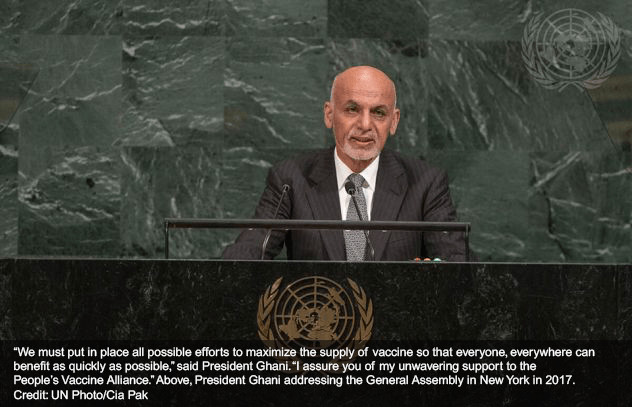
The President of Afghanistan, Mohammad Ashraf Ghani has joined world leaders and experts in an appeal for equitable and fair distribution of COVID-19 vaccines.
In a letter to the People’s Vaccine Alliance, President Ghani outlined that despite the numerous challenges Afghanistan continues to face as a country caught in conflict, Afghanistan has witnessed fewer human losses caused by the COVID-19 pandemic compared to other countries. However, the President underscored that this did not mean that the resulting implications were underestimated or ignored.
Read More
As the COVID-19 pandemic continues, the ongoing global health crises and resulting economic consequences of the measures imposed to contain COVID-19 have highlighted the vast and rapidly growing inequities threatening the livelihoods of the most vulnerable.
This has been especially true for transgender people around the world, who have disproportionally borne the socioeconomic hardships of the pandemic. Speaking about the transgender community in India, transgender activist Laxmi Narayan Tripathi said, “People didn’t have money to pay rent. Not even to buy rice. People may die of COVID-19, but they may die of hunger even sooner.” The Kineer Services, an initiative created by Mrs Tripathi focusing on creating employment for the transgender community in India, organized and created a platform to provide food to the transgender community across several states in India in order to tide people over the immediate hardship. Sustainable support, however, is a challenge. “What else would be better than us empowering our own people, those that are living on the margins of society, to become entrepreneurs?” Ms Tripathi added.
Read More
The global health emergency caused by the COVID-19 pandemic has brought existing inequalities to the forefront, has exposed transgender and gender-diverse communities to a heightened risk of social exclusion, stigma and discrimination, has reduced access to health care and has caused financial insecurity.
“COVID-19 has created an existential threat to many transgender people in Asia and the Pacific. But trans-led organizations and groups have found creative ways to assist their communities, to offer support against social isolation and to support trans and gender-diverse people, especially those unable to work due to COVID-19. We recognize the importance of trans leadership and their response to communities greatly affected by the pandemic,” said Joe Wong, Executive Director of the Asia Pacific Transgender Network (APTN).
Read More
Many people have been able to work from home during the COVID-19 pandemic and continue to be paid, but low-income workers often haven’t had that opportunity.
In Indonesia, the latest labour force survey results show that 29 million workers have been affected by the pandemic, with 24 million workers suffering from cuts in hours of work and income. Average wages were depressed by 5.2% between 2019 and 2020. Surveys conducted by the Indonesia AIDS Coalition show that the situation is similar for people living with HIV and key populations—more than 80% of 529 respondents had experienced a reduction or loss of income due to the pandemic.
Read More
Wang Tang (not his real name) had never been to Nepal before, but at the end of March 2020 it was one of the few countries that had not closed its borders with China. Since he was desperate to get away from Beijing after having had to stay at home for months after the coronavirus outbreak spread throughout China, he bought a ticket.
But days after he arrived, while he was staying in Pokhara, the fourth stop on his trip, the local government announced that the city would be shut down. He heard that the lockdown would not last longer than a month.
Read More
A new scoping review examines sexualized drug use (SDU) among men who have sex with men and transgender women in Asia, in order to understand the socio-sexual context of drug use, to inform effective HIV and drug policy and programmatic responses in Asia, and to guide future qualitative research in the region.
Bangkok, 10th March 2021 – To shed light on sexualized drug use among men who have sex with men (MSM) and transgender women (TGW) in Asia, APCOM commissioned a scoping review of locally informed qualitative research under the technical guidance of Dr Angela Kelly-Hanku, Papua New Guinea Institute of Medical Research / Kirby Institute, University of New South Wales, Australia and Jamee Newland, University of New South Wales (Australia) and financial support of the UNAIDS Regional Office for Asia and the Pacific. The objective of APCOM’s scoping review, titled “A qualitative scoping review of sexualised drug use (including Chemsex) of men who have sex with men and transgender women in Asia”, was to inform effective HIV, harm reduction and programmatic responses in the region, and to guide future qualitative research in the Asia.
Read More
Bangkok, Thailand, 8th of March, 2021 – To mark International Women’s Day, the International Community of Women Living with HIV Asia and the Pacific (ICWAP), in collaboration with UNAIDS AP, is launching a social media campaign on the leadership of women and girls living with HIV from Asia and the Pacific during the COVID-19 pandemic. The campaign calls to close in on inequalities that drive vulnerabilities to overcome the COVID-19 health crisis and end the AIDS epidemic.
This year’s theme for International Women’s Day is Women in leadership: Achieving an equal future in a COVID-19 world that celebrates the tremendous efforts by women and girls around the world in shaping a more equal future and recovery from the COVID-19 pandemic. International Women’s Day is a time to reflect on progress made, to call for change and to celebrate acts of courage and determination by women and girls, who have played an extraordinary role in the history of their countries and communities. “Women leaders have provided a guiding light for the world in responding to the COVID-19 crisis, from heads of government to coordinators of grass-roots social movements,” says Eamonn Murphy, UNAIDS Regional Director for Asia and the Pacific.
Read More