 UNAIDS Asia-Pacific

The HIV response in the Philippines has been hit by the COVID-19 pandemic, especially access to HIV prevention and treatment services. According to the Global Fund to Fight AIDS, Tuberculosis and Malaria, in Metro Manila coverage of HIV prevention services for gay men and other men who have sex with men has decreased by 74% since 2019. Government figures show that compared to 2019, in 2020 HIV testing decreased by 61% and enrolment in HIV care reduced by 28%. The COVID-19 pandemic has drawn attention to socioeconomic divides, highlighting failures within the health system to adequately deal with not one pandemic but two.
Read More
Manila/Bangkok, 10 May 2021: The UNAIDS Executive Director Winnie Byanyima will embark on her first virtual mission, a two-day visit to the Philippines to speak with communities, civil society leaders and representatives from the government to discuss the country’s response to the HIV and COVID-19 pandemic. The virtual mission comes at an opportune time, just before the UN Member States, including the Philippines, will come together on 8-10 June 2021 for the United Nations High-level Meeting on HIV and AIDS to renew commitment to ending AIDS as a public health threat by 2030.
Read More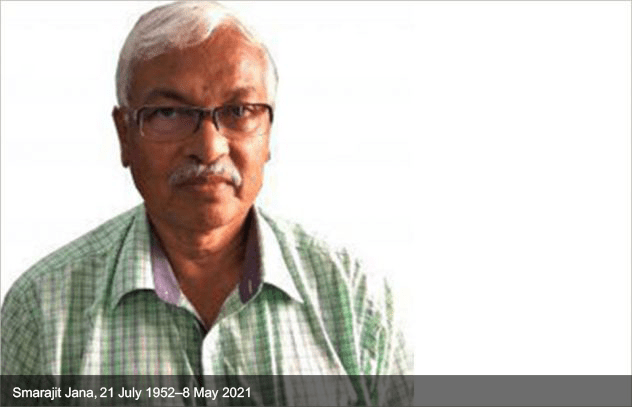
By Nandini Kapoor, Community Support Adviser, UNAIDS Country Office for India
The death of Smarajit Jana has left us shaken. True to his nature, he fought COVID-19 valiantly, but sadly the champion for the response to HIV succumbed to the coronavirus.
How do you begin to describe Mr Jana? A medical doctor, a public health specialist, an epidemiologist, a researcher and academician, an ardent advocate for the response to HIV and the architect of India’s national HIV response for key populations, a champion of human rights and the dignity of sex workers, the founder of the Durbar Mahila Samanwaya Committee (DMSC) collective of sex workers, a winner of national and international honours and accolades, a distinguished voice in domestic and global forums, and much more.
Read More
More than 150 civil society representatives from 17 countries in Asia and the Pacific joined the first virtual regional consultation on the upcoming United Nations High-Level Meeting on AIDS.
“Your views are important. We need them, and they really matter for the success of the political declaration,” said Mitch Fifield, Australia’s Ambassador and Permanent Representative to the United Nations and one of the two co-facilitators for the high-level meeting process, in his opening remarks. He also spoke about the valuable contributions of the participants to the high-level meeting and the critical role of communities in the HIV response.
Read More
Social media campaign for Asia and the Pacific
The High-Level Meeting (HLM) on HIV and AIDS will take place between 8 and 10 June 2021. The HLM will review the progress made in reducing the impact of HIV since the last United Nations General Assembly High-Level Meeting on HIV and AIDS in 2016 and is expected to adopt a new political declaration to guide the future direction of the response. The HLM and the accompanying political declaration will provide a critical opportunity to review progress towards the 2016 targets and political declaration, endorse new 2025 targets to ensure accountability and keep the world on track to ending the AIDS epidemic as a public health threat, and come with an agreement on a new Political Declaration for the next five years of the HIV response to end the AIDS epidemic by 2030. The proposed new Political Declaration will be informed by the new Global AIDS Strategy 2021–2026. Regions and countries will play an essential role in developing regional priorities to underpin and feed into the declaration’s consultative and negotiation phases. The participation of the communities and organisations of people living with HIV, key populations and other vulnerable populations will be fundamental for the success of the HLM.
Read More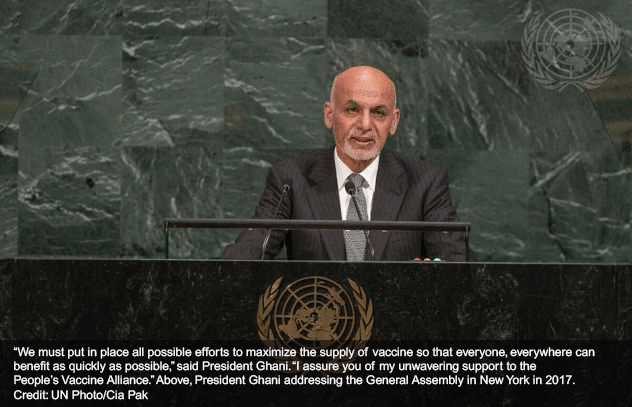
The President of Afghanistan, Mohammad Ashraf Ghani has joined world leaders and experts in an appeal for equitable and fair distribution of COVID-19 vaccines.
In a letter to the People’s Vaccine Alliance, President Ghani outlined that despite the numerous challenges Afghanistan continues to face as a country caught in conflict, Afghanistan has witnessed fewer human losses caused by the COVID-19 pandemic compared to other countries. However, the President underscored that this did not mean that the resulting implications were underestimated or ignored.
Read More
As the COVID-19 pandemic continues, the ongoing global health crises and resulting economic consequences of the measures imposed to contain COVID-19 have highlighted the vast and rapidly growing inequities threatening the livelihoods of the most vulnerable.
This has been especially true for transgender people around the world, who have disproportionally borne the socioeconomic hardships of the pandemic. Speaking about the transgender community in India, transgender activist Laxmi Narayan Tripathi said, “People didn’t have money to pay rent. Not even to buy rice. People may die of COVID-19, but they may die of hunger even sooner.” The Kineer Services, an initiative created by Mrs Tripathi focusing on creating employment for the transgender community in India, organized and created a platform to provide food to the transgender community across several states in India in order to tide people over the immediate hardship. Sustainable support, however, is a challenge. “What else would be better than us empowering our own people, those that are living on the margins of society, to become entrepreneurs?” Ms Tripathi added.
Read More
The global health emergency caused by the COVID-19 pandemic has brought existing inequalities to the forefront, has exposed transgender and gender-diverse communities to a heightened risk of social exclusion, stigma and discrimination, has reduced access to health care and has caused financial insecurity.
“COVID-19 has created an existential threat to many transgender people in Asia and the Pacific. But trans-led organizations and groups have found creative ways to assist their communities, to offer support against social isolation and to support trans and gender-diverse people, especially those unable to work due to COVID-19. We recognize the importance of trans leadership and their response to communities greatly affected by the pandemic,” said Joe Wong, Executive Director of the Asia Pacific Transgender Network (APTN).
Read More



 UNAIDS Asia-Pacific