UNAIDS Asia-Pacific
Young key populations leadership and innovations in the HIV response in Asia and the Pacific
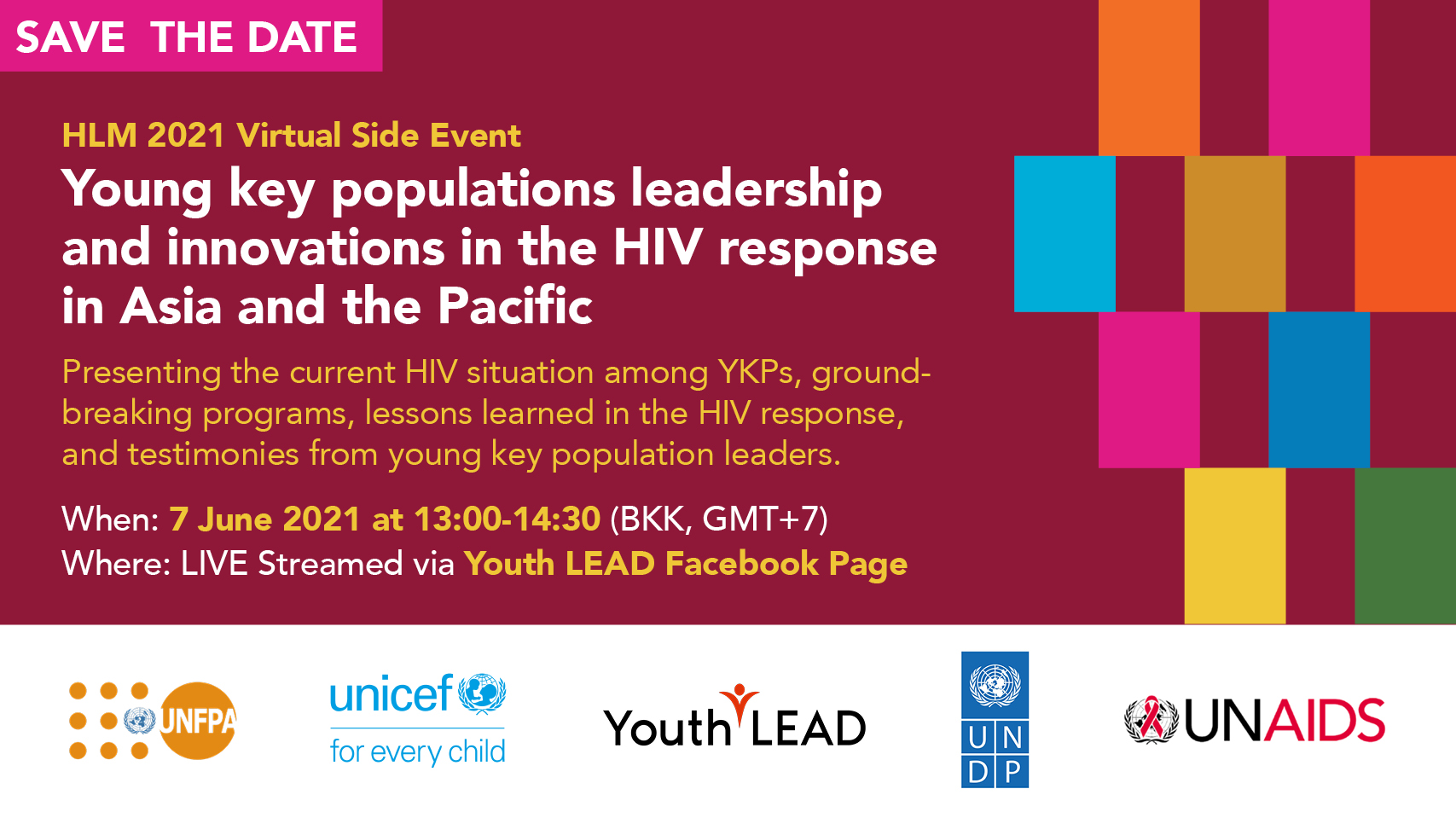
The young key populations’ side event at the High-Level Meeting on HIV and AIDS 2021 will highlight YKP specific issues from the Asia Pacific and shed light on the current HIV epidemic amongst YKPs. The panel consisting of young key populations, youth innovators, the Ambassador of Health and Security Australia and the Government of Thailand will share ground-breaking programs, lessons learned, and testimonies from young key populations leaders. The side event will also offer good examples of YKP leadership and their contributions to the HIV response, including the COVID-19 response and share lessons learned from innovative HIV and SRHR programs targeted to YKP.
Date and Time: Monday 7th June 2021 at 13:00 – 14:30 (Bangkok Time)
How: Streamed live via YouTube https://youtu.be/vWqQtlOG0cc | Facebook: facebook.com/YouthLEADAP
Click here to view the concept note for this side event
This side event is co-organised by Youth LEAD, UNAIDS Asia Pacific, UNFPA APRO, UNICEF EAPRO and UNDP Bangkok Regional Hub

For Vanessa Chaniago, a young transgender woman living in Jakarta, Indonesia, the first few months of the COVID-19 pandemic were filled with fear. “I was really struggling to make ends meet. I had been working for a civil society organization, which was a great place to learn and develop strong networks, but unfortunately the income was not sufficient to sustain me and my family. My income drastically declined,” she said.
According to a survey conducted by the Crisis Response Mechanism (CRM) Consortium of 300 lesbian, gay, bisexual, transgender and intersex (LGBTI) people in Indonesia, the COVID-19 pandemic has caused most LGBTI people to have experienced layoffs or reductions in income or to close their businesses. Most LGBTI people work in sectors with a higher risk of COVID-19: 20.5% in the beauty industry, 19.5% in the health sector and 12.8% in the service industry. Unfortunately, most of the respondents do not have long-term savings—30% would only be able to survive for two to three months on their savings, and 64% are not able to access loans.
Read More
Message by Eamonn Murphy, UNAIDS Regional Director for Asia and the Pacific
Today, the 17th of May is the International Day Against Homophobia, Biphobia, Intersexism and Transphobia. This year’s theme is “Together: Resisting, Supporting, Healing!”
The powerful theme was chosen due to the recent challenges that the world has faced this past year.
Lesbian, gay, bisexual, transgender, intersex, queer people and people in all their diversity continue to face high levels of violence and inequalities. Punitive laws continue to criminalize their behaviours, identities and gender expressions. Stigma and discrimination is still pervasive and jeopardizes their access to health, education and work.
Read More
The HIV response in the Philippines has been hit by the COVID-19 pandemic, especially access to HIV prevention and treatment services. According to the Global Fund to Fight AIDS, Tuberculosis and Malaria, in Metro Manila coverage of HIV prevention services for gay men and other men who have sex with men has decreased by 74% since 2019. Government figures show that compared to 2019, in 2020 HIV testing decreased by 61% and enrolment in HIV care reduced by 28%. The COVID-19 pandemic has drawn attention to socioeconomic divides, highlighting failures within the health system to adequately deal with not one pandemic but two.
Read More
Manila/Bangkok, 10 May 2021: The UNAIDS Executive Director Winnie Byanyima will embark on her first virtual mission, a two-day visit to the Philippines to speak with communities, civil society leaders and representatives from the government to discuss the country’s response to the HIV and COVID-19 pandemic. The virtual mission comes at an opportune time, just before the UN Member States, including the Philippines, will come together on 8-10 June 2021 for the United Nations High-level Meeting on HIV and AIDS to renew commitment to ending AIDS as a public health threat by 2030.
Read More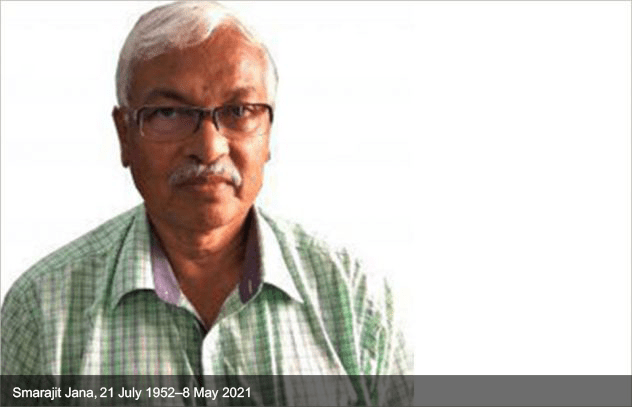
By Nandini Kapoor, Community Support Adviser, UNAIDS Country Office for India
The death of Smarajit Jana has left us shaken. True to his nature, he fought COVID-19 valiantly, but sadly the champion for the response to HIV succumbed to the coronavirus.
How do you begin to describe Mr Jana? A medical doctor, a public health specialist, an epidemiologist, a researcher and academician, an ardent advocate for the response to HIV and the architect of India’s national HIV response for key populations, a champion of human rights and the dignity of sex workers, the founder of the Durbar Mahila Samanwaya Committee (DMSC) collective of sex workers, a winner of national and international honours and accolades, a distinguished voice in domestic and global forums, and much more.
Read More
More than 150 civil society representatives from 17 countries in Asia and the Pacific joined the first virtual regional consultation on the upcoming United Nations High-Level Meeting on AIDS.
“Your views are important. We need them, and they really matter for the success of the political declaration,” said Mitch Fifield, Australia’s Ambassador and Permanent Representative to the United Nations and one of the two co-facilitators for the high-level meeting process, in his opening remarks. He also spoke about the valuable contributions of the participants to the high-level meeting and the critical role of communities in the HIV response.
Read More
Social media campaign for Asia and the Pacific
The High-Level Meeting (HLM) on HIV and AIDS will take place between 8 and 10 June 2021. The HLM will review the progress made in reducing the impact of HIV since the last United Nations General Assembly High-Level Meeting on HIV and AIDS in 2016 and is expected to adopt a new political declaration to guide the future direction of the response. The HLM and the accompanying political declaration will provide a critical opportunity to review progress towards the 2016 targets and political declaration, endorse new 2025 targets to ensure accountability and keep the world on track to ending the AIDS epidemic as a public health threat, and come with an agreement on a new Political Declaration for the next five years of the HIV response to end the AIDS epidemic by 2030. The proposed new Political Declaration will be informed by the new Global AIDS Strategy 2021–2026. Regions and countries will play an essential role in developing regional priorities to underpin and feed into the declaration’s consultative and negotiation phases. The participation of the communities and organisations of people living with HIV, key populations and other vulnerable populations will be fundamental for the success of the HLM.
Read More